To identify a trusted investment advisor in Dubai, first verify the firm and the individual on the DFSA, SCA, or ADGM FSRA public registers. Confirm permissions (e.g., “Advising on Financial Products”), fee model, and client classification. Keep a paper trail—risk profile, suitability report, and signed client agreement—before funding.
Do this next
- Verify the licence: Search DFSA/SCA/FSRA registers for the firm and advisor; match legal names and permissions.
- Confirm scope & fees: Get a written fee schedule and the exact authorised activities.
- Paper trail: Proceed only after risk profiling, a suitability report, and a signed client agreement.
What “licensed & authorised” really means in Dubai
DIFC vs Mainland vs ADGM (at a glance)
- DIFC is regulated by the DFSA; firms hold specific permissions (e.g., Advising on Financial Products).
- Mainland UAE advisory is regulated by the SCA (e.g., Financial Consultation & Analysis).
- ADGM firms are regulated by the FSRA; some Dubai-facing firms operate from ADGM.
Firm licence and individual approval
A credible setup has both an authorised firm and approved individuals (often called Authorised Individuals). Job titles alone don’t matter—your service must match the firm’s permissions and any retail endorsement like a trusted investment consultant in Dubai demonstrates compliance and transparency that clients can depend on.
5-minute licence check
Step 1: Identify the legal name
Collect the registered legal name of the firm and your contact’s full name and role.
Step 2: Search the right register
- DFSA (DIFC): Review Firms and Individuals; note permissions and any retail endorsement.
- SCA (Mainland): Confirm the company is licensed for Financial Consultation & Analysis (or the relevant activity).
- ADGM FSRA: Check the Financial Services Permission and current status.
Step 3: Match permissions to the service
Ensure the licence covers your need (e.g., Advising on Financial Products). A Representative Office cannot provide product-level advice.
Step 4: Capture proof
Keep screenshots and reference numbers. Ask for written confirmation of your client classification (Retail or Professional) and the disclosures you will receive.
Licence cheat sheet (print-friendly)
| Where the advisor operates | Regulator | What to check on the register | What it should say (examples) |
|---|---|---|---|
| DIFC (Dubai) | DFSA | Firm status, permissions, retail endorsement, individual approvals | “Advising on Financial Products”, “Arranging Deals in Investments”; named Authorised Individuals |
| Mainland UAE | SCA | Company listed as Licensed; activity type | “Financial Consultation & Financial Analysis” |
| ADGM (Abu Dhabi) | FSRA | Financial Services Permission: status, scope | Permission set covering the intended advisory activity |
Fees, conflicts, and reporting
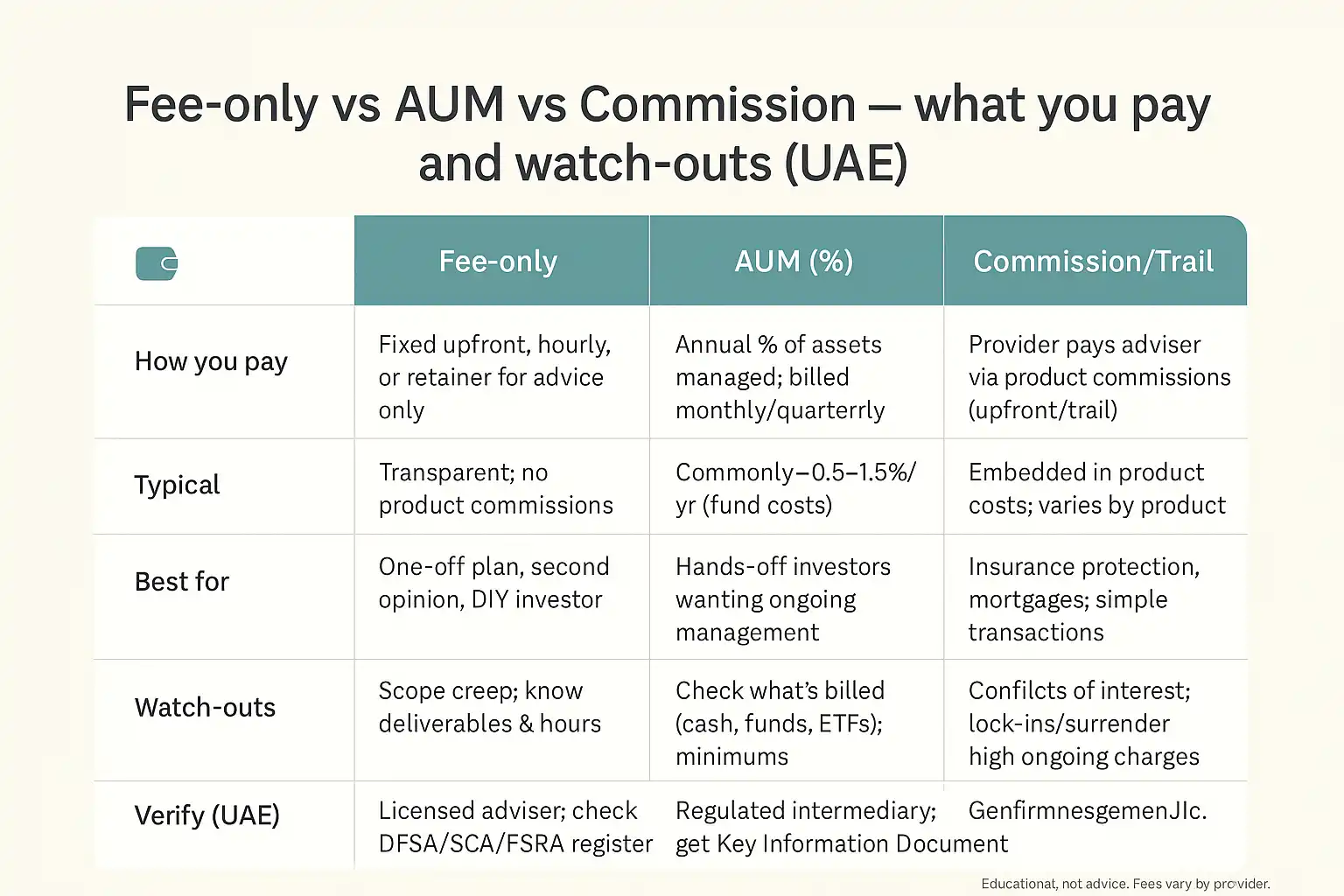
Fee models (know what you pay)
- Fee-only: Flat/hourly/retainer tied to advice only—cleanest conflict profile.
- AUM-based: % of assets; aligns incentives, but monitor platform and fund fees.
- Commissioned: Product pays the advisor; insist on full commission disclosure.
Fee model quick table
| Model | You pay | Best for | Watch-outs |
|---|---|---|---|
| Fee-only | Fixed/Hourly/Retainer | Complex planning, unbiased selection | Scope creep; agree deliverables |
| AUM % | ~0.5%–1.5% typical | Ongoing portfolio management | Layered custody/fund/FX fees |
| Commission | Embedded in product | Term insurance, simple needs | Product bias; lock-ins/penalties |
Service quality signals to confirm
Mandatory documents & process
Expect risk profiling and a suitability report before recommendations, a client agreement covering fees/services/complaints, and ongoing reporting (performance, asset mix, and all fees paid).
Experience & credentials
Ask for CVs and recognised qualifications (e.g., CISI Level-4+, CFP, CFA). Confirm each advisor is an approved individual under the relevant regulator.
Product access & custody
Know where assets are held (custodian/broker), who has discretion, withdrawal timelines, and all associated costs.
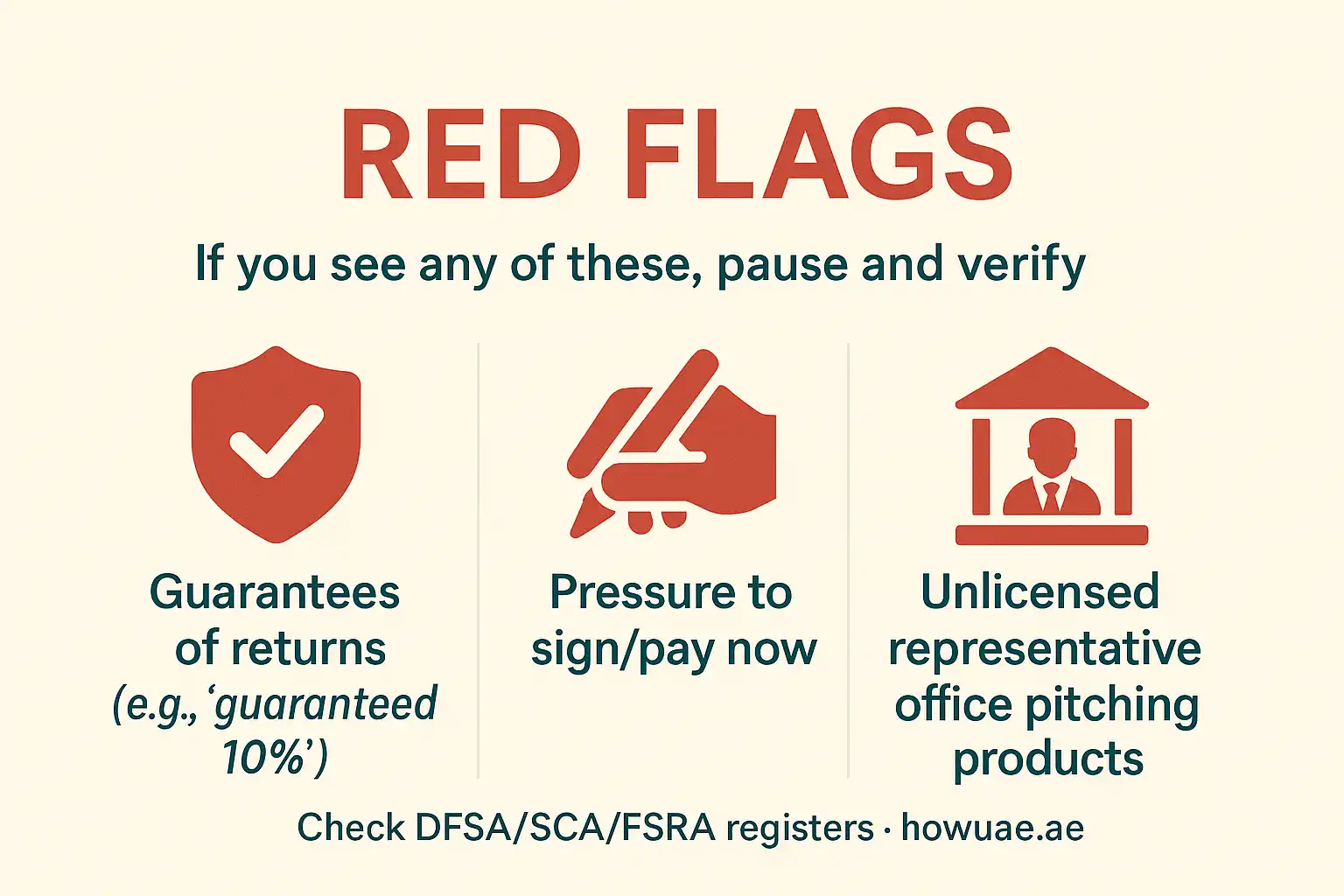
Red flags
| Red flag | Why it matters | Safer alternative |
|---|---|---|
| Guaranteed returns or “no-risk” claims | Unrealistic and non-compliant | Written risk disclosure + diversified strategy |
| Pressure to sign/fund today | Short-cuts due diligence | Cooling-off time; independent licence check |
| Representative Office pitching products | Not permitted to advise | Deal only with firms authorised for Advising |
| Hidden or vague fees | Surprises and conflicts later | Pre-contract fee schedule + total-cost example |
| Unclear client classification | Protections differ by class | Confirm Retail vs Professional in writing |
Questions to ask a trusted investment advisor in Dubai
Scope & permissions
- Which permissions cover the advice you will provide to me?
- Am I classified Retail or Professional, and what does that change?
Costs & conflicts
- Show me all fees I will pay in a typical year (advice, platform, fund, FX).
- Do you receive any commissions or soft-dollar benefits?
Controls & recourse
- Who is the custodian/broker? How do I view statements independently?
- What is your complaints process and which regulator handles disputes?
If something goes wrong
Complaints and escalation
Start with the firm’s internal complaints process (get a case number). If unresolved, escalate based on jurisdiction: DFSA (DIFC firms), SCA (mainland firms), or CBUAE (bank-issued products/consumer protection). Keep copies of all emails, statements, and timelines.
Pro Tip: Before moving money, email the advisor: “Please confirm in writing the regulatory permissions under which you will advise me, my client classification, all fees I will pay in year one, and your complaints escalation path.” File their reply with your account documents.
FAQs
Is “financial advisor” a protected title in the UAE?
Not by title alone. What matters is whether the firm is authorised for the relevant financial service (e.g., Advising on Financial Products) and whether your contact is an approved individual. Always verify on the DFSA, SCA, or FSRA public registers, not just the firm’s website.
What is a DFSA Category 4 licence?
A DIFC prudential category commonly used for non-discretionary advisory and arranging activities (e.g., advising on financial products, arranging deals). Some firms also have a retail endorsement to serve retail clients. Confirm exact permissions on the register.
Can a Representative Office advise me on products?
No. A Representative Office is limited to general information and introductions and cannot advise on specific products. If you receive product-level advice, the firm must be authorised for Advising and the individual must be approved.
Where do I complain if I’m a bank client (not a DIFC firm)?
Submit a complaint to the bank first. If unresolved, escalate under the CBUAE Consumer Protection framework. For DIFC-regulated firms, escalate to the DFSA; for mainland non-bank advisors, escalate to the SCA—depending on who regulates the firm.