Wondering why to invest in Dubai right now? This guide explains why to invest in Dubai real estate in 2026 , with rental yields in Dubai, DLD fees, RERA escrow, and Golden Visa rules—so you can model a true net yield.
10 Reasons Why Invest in Dubai Real Estate?
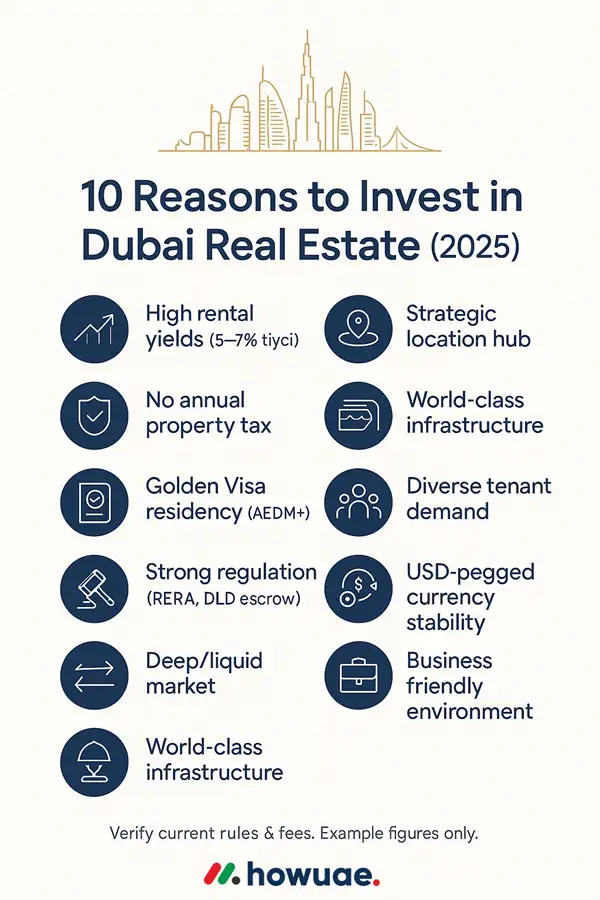
1. Depth And liquidity
Dubai’s market isn’t just active; it’s deep. Transaction volumes in 2026 continue to show a large base of real buyers and sellers across off-plan and ready segments. That liquidity matters because it reduces friction at both entry and exit, which is exactly what income investors and global buyers need.
2. Yields that compete globally
In most established hubs, net yields on residential property trend low once you include taxes and holding costs. In Dubai, apartments commonly settle around ~5–7% net before leverage when you budget realistically for service charges, vacancy, and management. Villas can be lower on yield but stronger on family-led demand and upgrade paths.
3. Tax advantages that improve the “net.”
For individuals, there’s no personal income tax on rent and no annual property tax on homes in Dubai. You will still account for transfer and registration fees at purchase and ongoing service charges, but the absence of recurring property tax is a structural tailwind to long-term returns.
3. Residency pathway via property
Qualifying purchases currently allow eligible buyers to apply for long-term residency (the well-known 10-year “Golden Visa” at or above an AED 2M property value threshold, with rules around financing). For many overseas investors, that’s a lifestyle and mobility benefit stacked on top of the financial case.
4. Macro demand drivers that actually show up in rents.
Dubai’s role as a regional business hub, global tourism center, and logistics/aviation gateway translates into real occupier demand. Corporate relocations, new company formation, and long-stay tourism all funnel into absorption and renewal rates, which support rental income stability in the mid-market apartment segment and premium liquidity in flagship districts.
Risks You Should Respect and De-Risk Them
Market cycles and off-plan execution
Property is cyclical, and off-plan adds construction and delivery risk. De-risk by choosing reputable developers like “Dubai-Real.Estate“, using protected payment schedules, and setting realistic delivery timelines. If you don’t want development-style risk, focus on ready stock with documented service-charge history and recent leasing comps.
Service charges that erode yield
Buildings with lavish amenities often carry higher annual fees that chip away at returns. Request the latest service-charge schedule (AED/sqft), review owners’ association notices, and plug those numbers into your yield model before committing.
Vacancy and tenant quality
Homes near job hubs, schools, and transit typically lease faster and renew more smoothly. Prioritize liquid floor plans—1BRs and efficient 2BRs in mid-market communities—and budget a conservative vacancy allowance so your numbers still work in softer periods.
Short-let compliance
Holiday homes can outperform on income, but they require permits, renewals, and professional operations. If you prefer a simpler, steadier approach, a long-let with quality tenants often delivers more predictable net income with fewer moving parts.
Pro Tip
Don’t quote gross yield when making decisions. Benchmark “net yield after everything”—service charges, property management, vacancy, routine maintenance, and one-off purchase fees amortized over your planned hold. A headline 8% gross can compress to ~5–6% net once you account for reality.
Where the Numbers Make Sense
Income-first apartments
If your priority is steady rent over capital heroics, focus on Jumeirah Village Circle (JVC), Dubai Sports City, and Production City. These areas attract mid-income tenants who value efficient floor plans and practical amenities. Yields are typically stronger here—but be selective about building quality, management standards, and service-charge levels to protect your net.
Balanced performance and liquidity
Dubai Marina, Business Bay, and Downtown offer deep tenant pools and strong resale depth. Yields may sit a notch below pure-yield districts, yet liquidity and brand value can offset that—especially if you expect to rebalance or exit within a few years.
Capital preservation and lifestyle pull
Palm Jumeirah and Dubai Hills Estate suit buyers who prize long-term desirability and upgrade demand. Net yields can be lower, but buyer depth, asset quality, and exit liquidity support wealth-preservation strategies when timing your sale.
The Real Costs
Buying in Dubai is straightforward once you know the costs. One-time: DLD transfer 4%, trustee fee, agency ~2% (negotiable), mortgage registration 0.25% of the loan + bank valuation/processing, and a developer NOC on resale. Ongoing: service charges (AED/sqft), property management (if outsourced), maintenance, and landlord insurance. There’s no annual property tax on homes, which helps net yields.
A Simple Worked Example (2026)
Imagine a ready 1-bedroom in a mid-market community.
- Purchase price: AED 1,000,000
- Current annual rent: AED 85,000
- Service charges: about AED 10,500/year (e.g., ~AED 15/sqft on ~700 sqft; check the actual schedule)
- Property management: 5% of rent = AED 4,250
- Vacancy allowance: 5% of rent = AED 4,250
- Maintenance reserve: 0.5% of price = AED 5,000
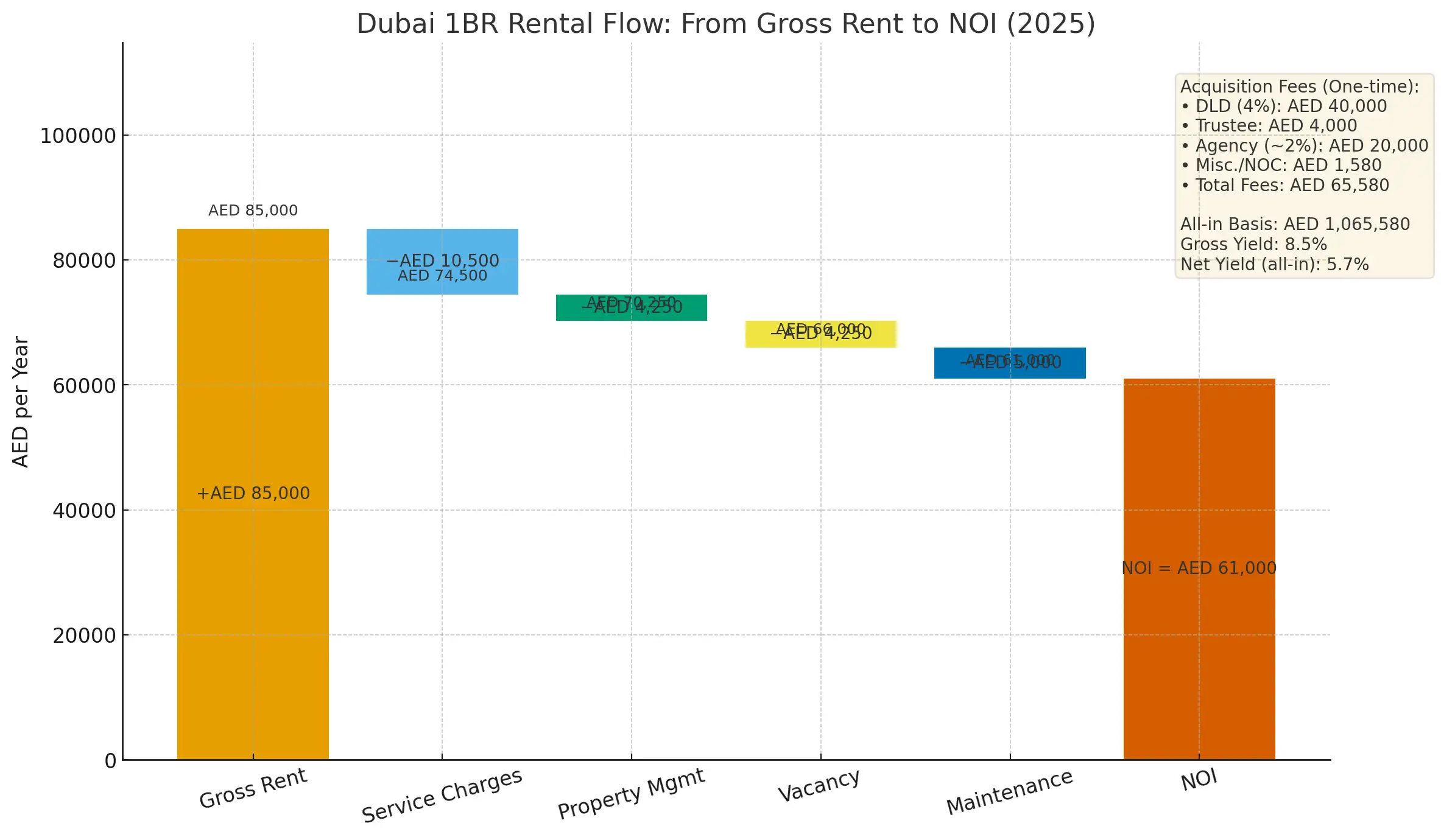
For one-time acquisition costs, assume DLD 4% (AED 40,000), trustee ~AED 4,000, agency 2% (AED 20,000), and misc./NOC ~AED 1,580, giving ~AED 65,580 total fees. Your gross yield is 85,000 ÷ 1,000,000 = 8.5%. After annual costs, NOI is ~AED 61,000. If you treat the all-in basis as AED 1,065,580 (price plus fees), your net yield on all-in is roughly 5.7%. This is a realistic mid-market benchmark in 2026; specific buildings will vary.
Short-Let or Long-Let?
Short-term lets can generate higher top-line income, but require proper permits, furnishing, active guest management, and contingency for seasonality. Long-let is simpler: fewer turnovers, lower furnishing outlay, and often better tenant stability. Many investors start with long-let to learn the building’s true operating costs, then test short-let with a single unit through a licensed operator.
How to Buy Real Estate in Dubai – Step by Step
- Set budget and get mortgage pre-approval if needed.
- Shortlist areas (yield/liquidity/lifestyle) and buildings with clean service-charge history and fresh leasing comps.
- Agree price, sign Form F/MOU, pay deposit, and complete valuation (if financing).
- Seller obtains the developer NOC.
- Transfer title at the trustee office; register mortgage if applicable.
- Set up utilities and, when renting, “register EJARI“. Done.
When This Strategy Isn’t a Fit
If you plan to hold for only a few months, the one-time transaction costs can overwhelm your returns. If your thesis depends entirely on holiday-home premium pricing without permitting or a professional operator, you’re taking on operational risk rather than pure real-estate risk. And if you’re considering off-plan purely for headline payment plans, make sure the developer’s track record and escrow arrangements are bullet-proof.
A Quick Case Study
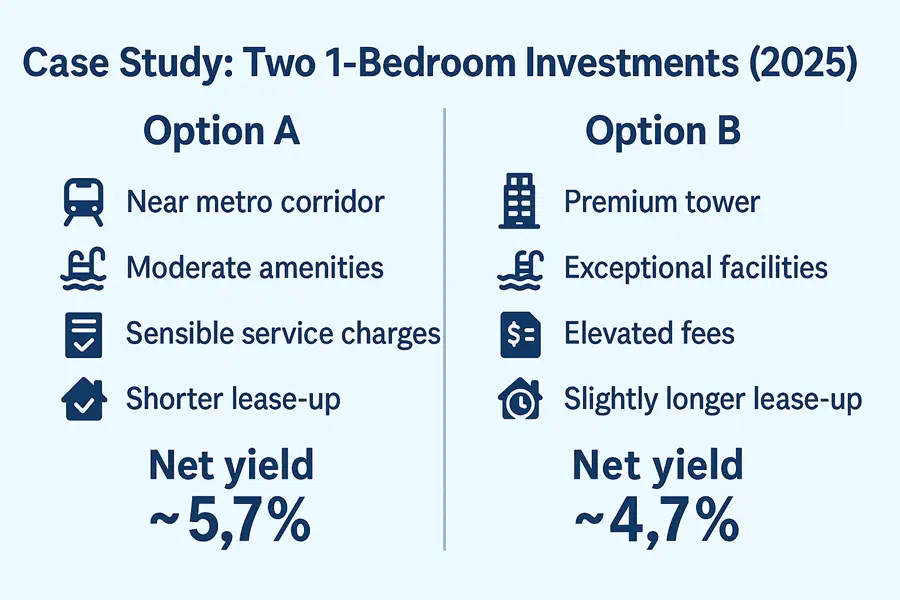
An overseas buyer wants income stability and compares two 1-bedrooms. Option A is a mid-market unit near a metro corridor with moderate amenities and sensible service charges.
Option B is a premium tower with exceptional facilities—and elevated fees. Both rent, but Option A nets ~5.7% on an all-in basis while Option B, after higher charges and slightly longer lease-up, nets ~4.7%. The investor chooses Option A for yield and later plans a diversification buy in a prime district for liquidity and capital preservation.
FAQ: Common Questions
Can foreigners buy freehold property in Dubai?
Yes. Non-UAE nationals can buy freehold property in Dubai, but only in designated freehold areas (e.g., Dubai Marina, Downtown, Business Bay, Palm Jumeirah, JVC, JLT, etc.). You fully own the unit and can sell, lease, or bequeath it.
Is rental income taxed for individuals?
For individuals, there’s no personal income tax on rent in Dubai and no annual property tax on residential units. You still budget for purchase fees and ongoing service charges.
Do I need a holiday home permit for short-term rentals?
Yes. Short-term/holiday lets require a Holiday Home permit (per unit, renewed annually) and building/HOA approval; non-compliant listings risk fines.
What yields are realistic in 2026?
Apartments typically land around ~5–7% net when you model vacancy, management, and charges conservatively. Villas can be lower on yield but strong on family-driven demand and upgrade cycles.
Can I obtain residency through property?
Yes. With qualifying property value from AED 2M, investors can apply for long-term residency (conditions apply, including how financed units are treated).
What are the main buyer fees?
Plan for DLD transfer at 4%, a trustee fee, an agency fee (often around 2%), and—if mortgaged—0.25% of the loan for mortgage registration, plus bank valuation/processing.
Are short-term rentals allowed?
Yes, but they require holiday-home permits and compliance with building/community rules. If you prefer less hassle, consider long-let.
How healthy is the market in 2026?
Transaction activity and leasing demand remain robust, with broad participation across price bands. Always review the latest quarterly figures for your target district before you commit.
What is EJARI and why does it matter for landlords?
EJARI is Dubai’s official tenancy registration. It’s required for utilities, supports dispute resolution, enforces rent rules, and proves who legally occupies your property.
What’s a realistic cap rate vs cash-on-cash in Dubai?
Cap rate: NOI ÷ value, typically ~5–7% for mainstream apartments.
Cash-on-cash: leveraged return; at ~70–80% LTV it’s often ~2–6% to start, depending on rate, fees, rent, and service charges.