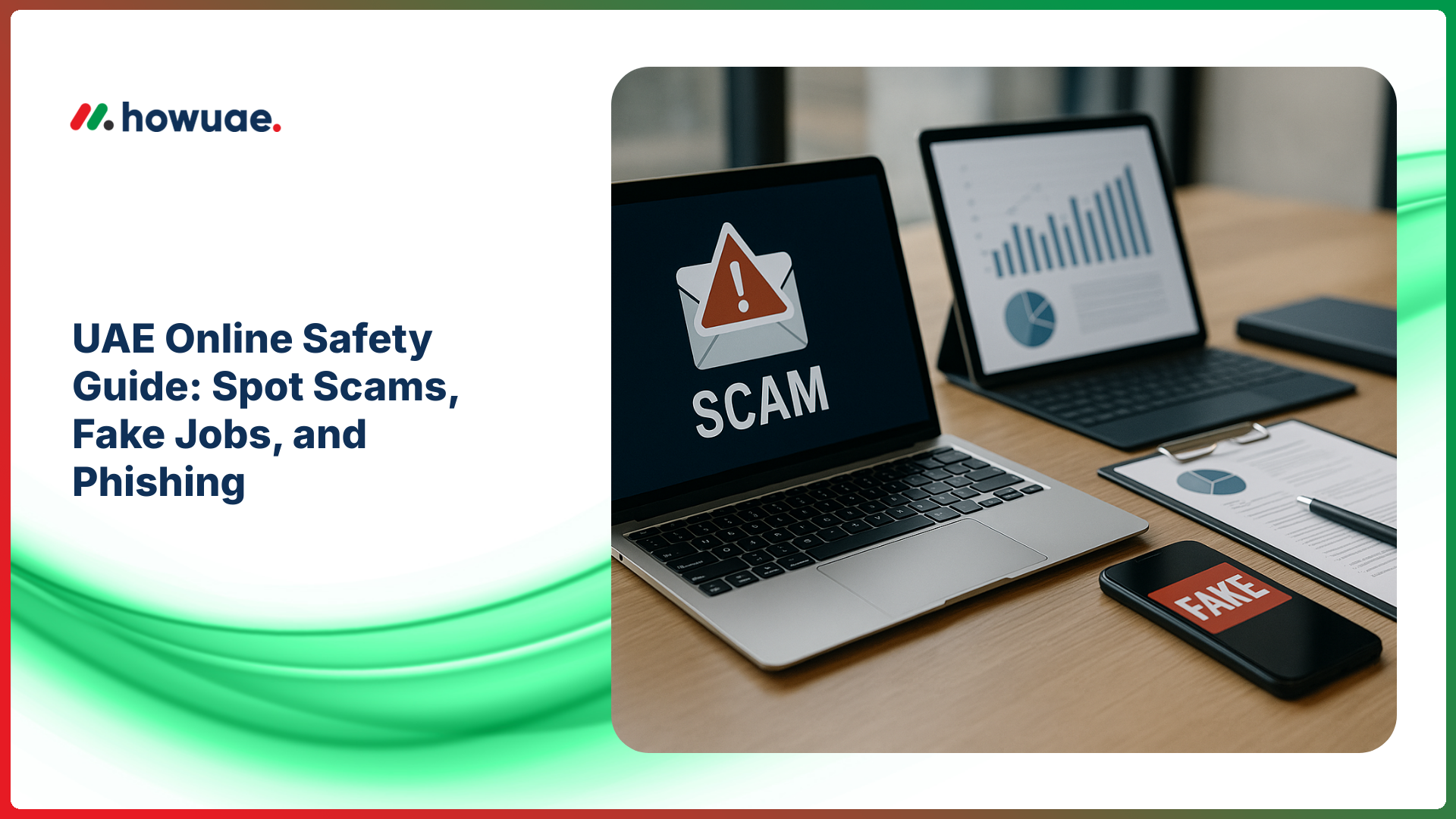
Online fraud is rising everywhere, and residents in the UAE are frequently targeted through WhatsApp, SMS, email, fake websites, and social media ads. This evergreen guide helps you recognize online scams UAE residents commonly face, avoid losing money or personal documents, and know exactly what to do if you suspect you’ve been targeted.
Why scams work (and why they’re common in the UAE)
Scammers succeed by creating urgency, authority, and confusion. In the UAE, fraud attempts often exploit real-life processes people rely on—Emirates ID delivery, visa renewals, banking verification, fines, job offers, and courier deliveries. The most effective scams are the ones that sound “almost official” and push you to act fast.
Remember: legitimate UAE banks, government entities, and major courier companies do not need your OTP, banking password, or card PIN to “verify” you. They also don’t threaten immediate arrest over a phone call or ask you to pay via gift cards, crypto, or personal transfer links.
The biggest online scam types in the UAE (with red flags)
1) Fake job offers and “easy salary” recruitment scams
These usually arrive via WhatsApp, Telegram, Instagram, or job boards, and promise high pay for simple tasks (rating apps, “data entry,” reviewing hotels, or remote “assistant” work). The scam may start with small payouts to build trust, then escalate to asking you to pay a “refundable deposit,” “training fee,” or “verification charge.”
- Upfront payments: Any request for a visa fee, onboarding payment, or “security deposit” is a major red flag.
- Too-fast hiring: No interview, no contract, and no company domain email address.
- Pressure tactics: “Limited slots,” “join now,” “pay today to secure your role.”
- Suspicious links: Shortened URLs or “application forms” asking for ID photos, bank details, or OTP.
Safer approach: Verify the company through official channels (company website, landline, and a corporate email domain). If the “HR” refuses to communicate via a company email or won’t share a verifiable office address, walk away.
2) Phishing links disguised as delivery updates, fines, or account alerts
Phishing messages often look like: “Your package is held,” “traffic fine due,” “bank account locked,” or “Emirates ID delivery failed.” They push you to click a link and enter card details, login credentials, or an OTP. In many cases, the page is a near-perfect clone of a real brand.
- Generic greetings: “Dear customer” instead of your name.
- Suspicious sender: Random mobile numbers, free email domains, or misspelled brand names.
- Urgency: “Pay in 30 minutes or your account will be blocked.”
- Payment traps: “Small fee” pages that request full card details and OTP.
Safer approach: Never open payment links from messages. Instead, type the official website yourself in the browser or use the official app.
3) Banking and OTP scams (“Your account is blocked”)
These are among the most damaging. A scammer calls pretending to be from your bank, the police, or a “security department” and tries to get your OTP, online banking password, card PIN, or Emirates ID details. They may claim there is “suspicious activity,” a “refund,” or a “verification process.”
Rule: If anyone asks for your OTP, PIN, or banking password, it is a scam—no exceptions.
- Spoofed caller ID: The number may look local and “official.”
- Authority pressure: Mentions of police, court cases, travel bans, or deportation to scare you.
- Screen-sharing: Requests to install apps (remote access) so they can “help.”
If you’re unsure about a suspicious caller, use this guide to identify scam calls in UAE by number and reduce the risk of being manipulated by spoofed or unknown numbers.
4) Fake investment, crypto, and “guaranteed returns” scams
These begin with social media ads, WhatsApp groups, or someone claiming to be a “fund manager.” They show screenshots of profits, fake dashboards, or testimonials. Eventually, they ask you to deposit more to “unlock withdrawals,” pay “taxes,” or pay “verification fees.”
- Guaranteed profits: No legitimate investment can guarantee returns.
- Withdrawing blocked: “Pay one more fee to release your funds.”
- Pressure to recruit: Referral commissions, pyramid-like structures, or “team building.”
Safer approach: Treat unsolicited investment offers as high-risk. If you can’t independently verify the platform and its licensing, don’t transfer funds.
5) Visa, immigration, and document-processing scams
Scammers may impersonate visa service providers or claim you have immigration issues (overstay, absconding, visa cancellation problems). They then request payment to “fix” your status quickly.
- Fake urgency: “Pay now or you’ll be banned.”
- Private payment requests: Personal bank account transfers or crypto.
- Unverifiable paperwork: “Approval letters” that don’t match any official format.
When in doubt, verify your status yourself using official channels. This internal guide can help you avoid visa scams by doing a UAE visa validity check before paying anyone.
6) Fake loans, salary advances, and “instant cash” traps
Loan scams often target people urgently looking for funds. A “broker” promises quick approval with no documents, then asks for an upfront “processing fee,” “insurance,” or “activation charge.” After you pay, they disappear—or keep asking for more.
- Upfront charges: Real lenders disclose fees transparently; scam lenders demand payment first.
- No eligibility checks: “Approved for everyone” is not realistic.
- Threats: Harassment if you hesitate or refuse to pay more.
7) Marketplace, rental, and classified ad scams
Common examples include fake apartment listings, fake landlord agents, “reservation fees,” and buyers who send fake transfer confirmations. Another version: a scammer sends you a link to “receive money,” which is actually a payment authorization page.
- Too-good pricing: Unreal rents or “urgent sale” discounts.
- Refusal to meet: “I’m abroad, pay the deposit to reserve.”
- Fake receipts: Screenshots of transfers are not proof of payment.
Quick checklist: 20 red flags for online scams in the UAE
Use this checklist any time you receive a suspicious message, call, or offer.
- They ask for OTP / PIN / online banking password.
- They want payment to a personal account (not a company account with a verifiable name).
- They pressure you to act immediately (“last chance,” “final warning,” “30 minutes”).
- They claim you’ll be arrested or banned unless you pay right now.
- They refuse official communication via a company email domain.
- The website domain is slightly misspelled or newly created.
- The link is shortened and hides the real destination.
- They request remote access or ask you to install unknown apps.
- They ask for Emirates ID photos “for verification” without a proper process.
- The message has poor grammar and generic greetings.
- They say you “won” something you never entered.
- They promise guaranteed returns or “risk-free” investment.
- They won’t let you verify independently (no callbacks, no office visit, no documentation).
- They move the conversation off-platform quickly (e.g., from a job site to WhatsApp).
- They ask for “refundable deposits” or “activation fees.”
- They demand payments via crypto or unusual methods.
- They send a “payment receive” link that actually charges you.
- They insist secrecy (“don’t tell the bank,” “keep this confidential”).
- They use fear + authority (police, courts, government threats).
- Something feels off. Trust that instinct and pause.
How to verify safely (before you click, pay, or share anything)
Step 1: Pause and confirm the story
Scams succeed when you’re rushed. Take 2 minutes to check: does the request make sense? Would an official entity really ask for this over WhatsApp?
Step 2: Don’t use their link—use official channels
If the message claims to be from a bank, courier, or government service, open the official app or type the official URL manually. If you cannot find the request in your official account dashboard, treat it as suspicious.
Step 3: Verify identities with a call-back you control
If someone calls claiming to be “support,” hang up and call the official number listed on the company website or your bank card. Do not call back the number that called you.
Step 4: Treat “screenshots” as marketing, not proof
Receipts, profit dashboards, “approval letters,” and chat screenshots can be fabricated in minutes. Trust only what you can verify independently.
If you think you’ve been scammed: what to do immediately
1) Stop the loss (time matters)
If you shared card details or an OTP, contact your bank immediately to freeze the card/account and dispute transactions. If you installed a remote access app, disconnect from the internet, uninstall the app, and change your banking and email passwords from a clean device.
2) Collect evidence (without engaging the scammer)
Save screenshots of chats, phone numbers, social media profiles, URLs, transaction IDs, and any payment receipts. Do not threaten the scammer—just document everything.
3) Report through official channels
Use official reporting guidance and local authorities. The UAE Digital Government portal provides UAE government guidance on reporting cybercrimes, including where to report depending on your emirate and situation.
If a report or follow-up is created, keep your reference number. You can also track and organize next steps using this internal resource for an online fraud case check in Dubai if your situation falls under Dubai jurisdiction.
4) Report financial fraud and protect future transactions
For banking-related incidents, review consumer guidance from the UAE Central Bank consumer protection information and follow your bank’s official complaint path. Also consider enabling transaction alerts, spending limits, and strong two-factor authentication on your accounts.
Everyday prevention: simple habits that block most scams
- Enable 2FA on email, banking, and social media accounts.
- Use a password manager and unique passwords per site.
- Lock your SIM with a PIN and keep your Emirates ID details private.
- Keep devices updated (OS and apps) to reduce exploit risk.
- Separate emails: one for banking/government, one for shopping and signups.
- Turn on bank alerts for every transaction, not just large amounts.
- Be careful with public Wi‑Fi for banking and payments.
- Teach family members (especially newcomers and seniors) the OTP rule.
Shareable “Do/Don’t” rules (copy/paste)
DO: Use official apps and websites, verify by calling official numbers, and keep evidence if something seems suspicious.
DON’T: Share OTP/PIN/passwords, install remote access apps for strangers, or pay “fees” to unlock withdrawals, deliveries, fines, or job offers.
FAQs
Is it safe to share my Emirates ID copy online in the UAE?
Only share Emirates ID copies when you have verified the recipient and the purpose is legitimate (e.g., regulated services). If a random “agent” on WhatsApp requests your ID for a vague “verification,” consider it a red flag. When possible, watermark copies with the date and purpose.
Are WhatsApp job offers common scams in the UAE?
Yes. Many fake job scams start on WhatsApp because it’s easy to impersonate recruiters and pressure people. Be especially cautious if the offer includes upfront fees, unusually high pay for simple tasks, or refusal to use a corporate email.
What should I do if I clicked a phishing link but didn’t enter details?
Close the page, do not download anything, and run a device security scan. If you entered any login credentials, change passwords immediately (starting with your email), and enable 2FA. Monitor your accounts for suspicious activity.
How can I reduce scam calls in the UAE?
Don’t answer unknown numbers repeatedly, block and report suspicious contacts, and avoid publishing your phone number publicly. If you’re trying to verify an unknown caller, use a trusted method to check the number and cross-check the story with official channels.
What’s the single biggest rule to remember about online scams UAE residents face?
Never share OTP, PIN, or banking passwords—no matter how official the caller or message sounds. If you’re pressured to act immediately, stop and verify independently.
Final takeaway
Most scams collapse when you slow down, verify independently, and refuse to share sensitive information. Keep this guide handy, share it with friends and coworkers, and use the checklist whenever a message feels urgent, “official,” or too good to be true.